
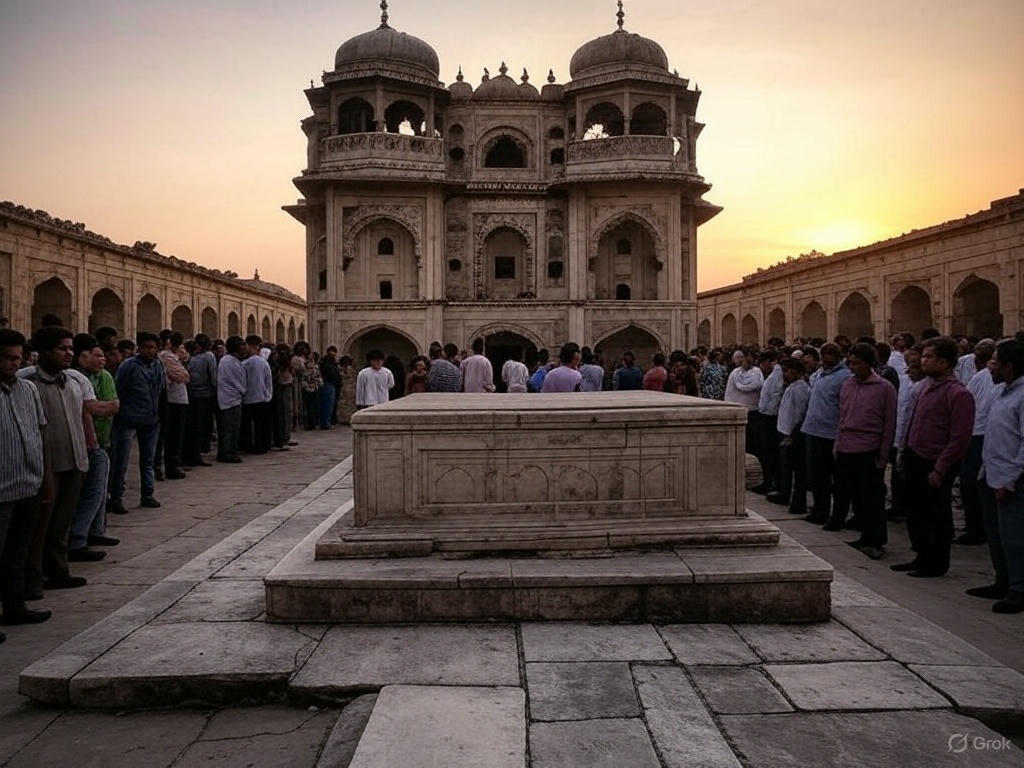
A storm of controversy has erupted in Uttar Pradesh as the legacy of Ghazi Saiyyad Salar Masud, a shadowy 11th-century figure, collides with modern sensibilities. In March 2025, the UP government banned the annual Neja Mela in Sambhal, a festival long tied to Masud’s memory, igniting debates over history, heroism, and who deserves veneration. Hailed as a saint by some, Masud’s story is far darker—a tale of conquest, plunder, and bloodshed that clashes with his saintly image. So, who was this man, why did the UP government pull the plug on his festival, and why is he no saint? Let’s unravel this saga of swords, shrines, and shattered myths.
Who Was Ghazi Saiyyad Salar Masud?
Step back to 1014 CE, when Saiyyad Salar Masud—often called Ghazi Miyan—was born, allegedly as the nephew of Mahmud of Ghazni, the notorious Turkic warlord who ravaged India 17 times. Historical records are murky, but the 17th-century Persian text Mirat-i-Masudi paints him as a zealous warrior who, at age 16, launched his own invasions after Mahmud’s death in 1030 CE. Crossing the Indus with a massive army, Masud carved a bloody path through Multan, Delhi, and Meerut, toppling local rulers and razing temples. His campaign peaked in 1033 CE near Bahraich, Uttar Pradesh, where he aimed to “neutralize” a sacred Sun temple with a mosque, per the Mirat.
But his spree ended abruptly. In 1034 CE, Raja Suheldev, a local chieftain, rallied 21 Hindu kings near Chittaura Lake and crushed Masud’s forces in the Battle of Bahraich. The invader fell, mortally wounded, and was buried where he died—his tomb later becoming a pilgrimage site. Known as a “Ghazi” (Islamic warrior-martyr), Masud’s legend grew, blending fact with folklore, but his deeds tell a stark tale of violence, not virtue.
Why Did the UP Government Ban the Neja Mela?
Fast forward to March 2025: the Neja Mela, a centuries-old fair in Sambhal honoring Masud, hit a wall. Held annually after Holi, it drew crowds hoisting a 30-foot pole with a green flag—until the UP government said no more. On March 17, Sambhal’s Assistant Superintendent of Police (ASP) Shirish Chandra declared, “No festival will honor a looter,” citing Masud’s role in pillaging the Somnath Temple alongside Mahmud and massacring countless locals. “History remembers him as a robber and murderer,” Chandra told a crowd seeking permission, a stance that went viral on X.
The ban wasn’t sudden. Hindu groups had long protested the mela, arguing it glorified an Islamic invader who ravaged their ancestors’ lands. The UP administration, under Chief Minister Yogi Adityanath, responded decisively. “Celebrating an invader is akin to strengthening treason,” Adityanath hinted in a March 20 speech, per Navbharat Times, without naming Masud directly. With forces deployed and legal threats issued, the government framed the ban as a law-and-order move—and a rejection of a “harmful tradition,” as Chandra put it.
Posts on X echoed the sentiment: “Those who plundered Somnath cannot be celebrated,” wrote @tisaiyan on March 17, reflecting a growing push to rethink historical figures like Masud. The decision rippled beyond Sambhal, with speculation swirling about a similar ban on Bahraich’s Jeth Mela, tied to the same figure.
Why Ghazi Saiyyad Salar Masud Is No Saint
Masud’s saintly aura—built over centuries—crumbles under scrutiny. The Mirat-i-Masudi, penned by Sufi scholar Abdur Rahman Chishti 600 years after Masud’s death, spins him as a pious warrior spreading Islam. It claims he cured a blind woman, Zuhra Bibi, and inspired devotion across faiths. His tomb in Bahraich, built by Sultan Firoz Shah Tughlaq in the 14th century, draws Hindus and Muslims alike, who see him as a healer or one of the “Panchon Pir” (five saints). Folklore even ties him to miracles, like blessing infertile couples.
But historians like Shahid Amin (Conquest and Community) call this a myth machine. The Mirat is more hagiography than history—Mahmud had no sister to birth Masud, and Ghaznavid chronicles skip him entirely. His “sainthood” smells of invention, likely crafted to legitimize a conqueror’s cult. Far from a holy man, Masud was a warlord who torched temples, looted wealth, and killed to expand an empire. “He’s an anti-hero, not a saint,” notes Amish Tripathi’s 2020 novel Legend of Suheldev, which casts him as a fanatic felled by a righteous king.
Contrast this with true saints—selfless, peaceful figures like Guru Nanak or Sant Kabir. Masud’s legacy is swords and subjugation, not serenity. His veneration, blending Hindu-Muslim syncretism, reflects a historical whitewash, not divine grace.
A Clash of Past and Present
The UP government ban on the Neja Mela isn’t just about one fair—it’s a reckoning with history. Masud’s story, once softened by time and tales, now faces a spotlight that reveals an invader’s legacy, not a saint’s. For conservationists, it’s irrelevant—his era’s wildlife impact is nil—but for cultural memory, it’s seismic. The move aligns with a broader push to honor defenders like Suheldev, whose statue Adityanath unveiled in 2021, over foreign aggressors.
Critics cry politics, noting the BJP’s Hindu voter base, but supporters see it as justice delayed. “If we can’t celebrate plunderers, we can’t ignore their victims,” tweeted @SouleFacts on March 17. As Bahraich’s Jeth Mela looms, the debate rages: should tradition trump truth? For now, Masud’s mela is silenced, his sainthood debunked, and his shadow—once sacred—stands exposed as a conqueror’s stain.