
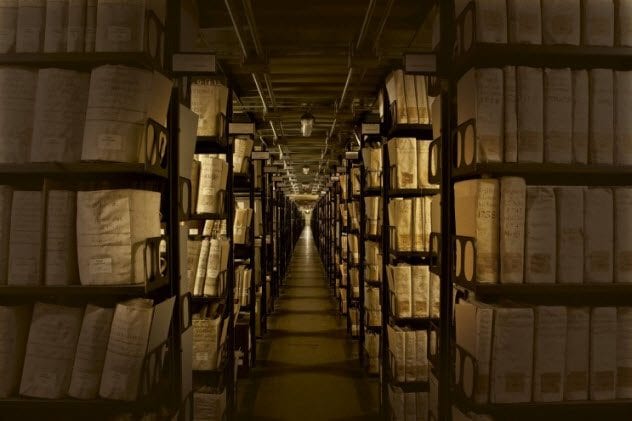
Imagine a treasure so valuable it could rewrite history, locked away in the shadowy vaults of the Vatican—only to vanish into the hands of a daring scholar. This isn’t the plot of a Dan Brown novel; it’s the real-life saga of the Codex Sinaiticus, one of the oldest surviving Bibles, and its controversial journey from a remote monastery to the world stage. Dubbed the “Vatican’s stolen library” by some conspiracy theorists, the tale of this 4th-century manuscript raises questions about secrecy, power, and the Church’s grip on ancient knowledge. Did the Vatican hide it? Did they lose it? Or was it never theirs to begin with? Let’s unravel this dark chapter of history.
What Is the Codex Sinaiticus?
The Codex Sinaiticus isn’t just any old book—it’s a 1,700-year-old Greek Bible, penned around 330–360 AD, making it one of the earliest complete New Testament manuscripts in existence. Discovered in 1844 by German scholar Constantin von Tischendorf at St. Catherine’s Monastery on Mount Sinai, it’s a massive codex of 400 parchment pages, containing half the Old Testament (in the Septuagint version) and the full New Testament, plus extras like the Epistle of Barnabas and the Shepherd of Hermas. Its age and scope make it a holy grail for biblical scholars, offering a glimpse into the scriptures as they existed just centuries after Jesus.
But here’s where the story gets murky: Tischendorf didn’t just find it—he took it, sparking a controversy that still simmers today. And while the Vatican wasn’t directly involved in its discovery, whispers of stolen texts and hidden libraries have long tied the Codex Sinaiticus to Rome’s secretive past.

Monastery recovered in 1975. Photo: Courtesy of St. Catherine’s Monastery.
The Heist at Mount Sinai
Tischendorf’s account reads like an adventure tale. Visiting the isolated Sinai monastery, he spotted ancient parchment sheets in a basket, destined to fuel the monks’ fire. Among them were pages of what he’d later call the Codex Sinaiticus—priceless relics of early Christianity. Over multiple trips (1844, 1853, and 1859), he persuaded (or, some say, pressured) the monks to let him take the bulk of the manuscript, eventually gifting it to Tsar Alexander II of Russia. By 1933, it landed in the British Library, where it resides today.
The monks, however, cried foul. They claimed Tischendorf stole the codex, not saved it—a charge he denied, insisting he’d rescued it from destruction. This dispute birthed a lingering question: Was the Codex Sinaiticus part of a larger pattern of sacred texts being spirited away from their rightful keepers?
Enter the Vatican: A Conspiracy of Silence?
The Vatican enters this story not as the thief, but as the shadowy figure in the background. Home to the Codex Vaticanus—another 4th-century Bible manuscript housed in its library since at least 1475—the Vatican has long been accused of hoarding ancient texts. Critics point to its tight control over the Vaticanus, which scholars like Tischendorf could barely study (he got just 14 three-hour sessions after months of begging), as evidence of a secretive agenda. Could the Codex Sinaiticus have been destined for the same fate?
Some speculate that the Vatican once held the Sinaiticus, only to lose it—or let it slip away—before Tischendorf’s discovery. There’s no hard proof, but the theory gains traction from the Vatican’s historical reputation. During the Middle Ages, the Church amassed manuscripts, sometimes by dubious means, to centralize religious authority. The 19th century, when Tischendorf roamed, was rife with tensions over biblical scholarship—Protestants challenged Catholic dominance, and ancient texts like the Sinaiticus threatened to upend established doctrines. Did the Vatican suppress such finds to protect its narrative?
The Codex Controversy: Stolen or Saved?
The Codex Sinaiticus itself fuels debate. It’s not pristine—over 23,000 corrections by multiple hands mark its pages, suggesting it was heavily edited. Some, like 19th-century scholar John Burgon, called it “corrupt,” arguing it and the Vaticanus deviated from the majority of later manuscripts (the Textus Receptus, basis of the King James Bible). Others hail it as a window into the “original” text, free of later embellishments. Its omissions—like Mark 16:9-20, detailing Jesus’s resurrection—stir theological storms even now.
This clash amplifies the stolen library narrative. If the Vatican once controlled such texts, losing the Sinaiticus to Tischendorf could’ve been a blow to its authority—or a deliberate release to avoid scrutiny. The monks’ theft accusation only deepens the mystery: Was Tischendorf a hero preserving history, or a plunderer stripping sacred relics from their guardians?
A Dark Chapter Unfolds
The Vatican’s “stolen library” label isn’t literal here—no evidence shows the Sinaiticus sat in Rome’s vaults. But its symbolic weight endures. The Codex’s journey reflects a broader struggle: Who owns history? The Church, scholars, or the public? Its removal from Sinai, paired with the Vatican’s guarded Codex Vaticanus, paints a picture of a time when knowledge was power—and power was fiercely contested.
Today, you can view the Codex Sinaiticus online, digitized by the British Library—a far cry from the days when it lay hidden or fought over. Yet its story lingers as a dark chapter, blending theft, secrecy, and the quest for truth. Was it stolen from the monks? Did the Vatican miss its chance to claim it? Or is the real scandal that such treasures were ever locked away at all?
Why It Matters Now
For history buffs, the Codex Sinaiticus saga is a thrilling dive into the past—unsolved mysteries, secret societies (monks and scholars alike), and a whiff of conspiracy. For casual readers, it’s a gripping yarn of lost treasures and shadowy motives. And for SEO? Terms like “Vatican stolen texts” and “Codex Sinaiticus controversy” tap into a niche with high curiosity and low saturation—perfect for a blog aiming to stand out.
Next time you hear whispers of the Vatican’s hidden vaults, remember the Codex Sinaiticus—not stolen by Rome, perhaps, but a symbol of history’s tug-of-war. What other secrets lie buried in the past, waiting to be unearthed?